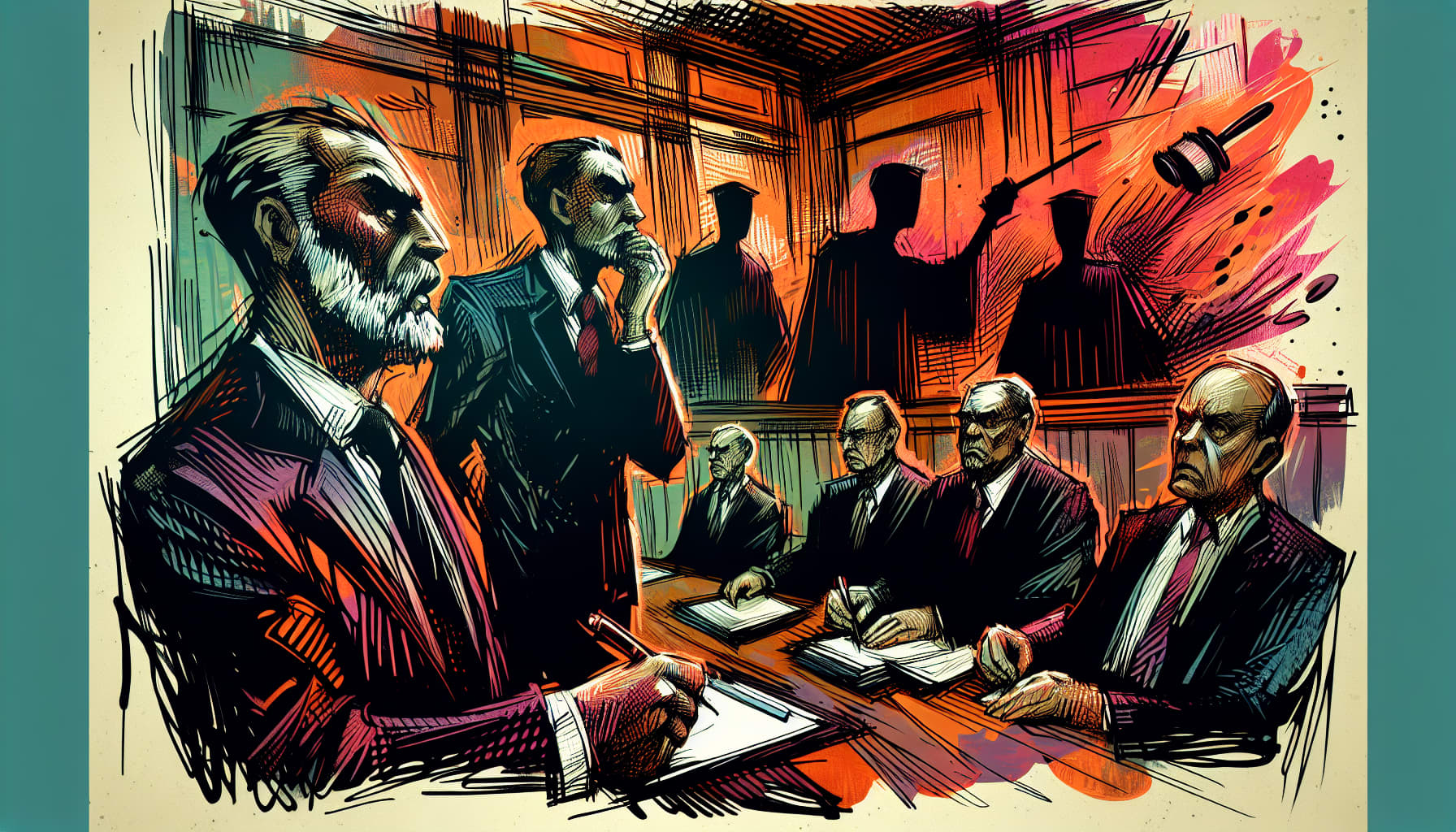
The US Supreme Court is currently grappling with a complex legal question: can someone be found guilty of a “crime of violence” under the Armed Career Criminal Act (ACCA) simply by failing to take action, rather than engaging in physical force? This intriguing issue was brought to the forefront in a high-profile case involving mafia bookmaker Salvatore “Fat Sal” Delligatti, a New York resident with connections to the Genovese crime family. Delligatti was apprehended for hiring gang members to carry out a hit on an individual he disliked. Although law enforcement intercepted the hitmen before any harm was done, Delligatti was nevertheless convicted of attempted murder. Furthermore, having a firearm while plotting this violent crime tacked on an additional five years to his sentence.
Delligatti’s lawyer, Allon Kedem, argued before the justices that crimes of inaction should not be classified as violent. Kedem suggested that “using physical force” implies the direct application of force on a victim, which, in his client’s case, did not occur. He likened this legal distinction to scenarios where passive behaviors, such as failing to provide medical care, result in harm but are not deemed acts of violence. The justices engaged in thought

Delligatti’s lawyer, Allon Kedem, argued before the justices that crimes of inaction should not be classified as violent. Kedem suggested that “using physical force” implies the direct application of force on a victim, which, in his client’s case, did not occur. He likened this legal distinction to scenarios where passive behaviors, such as failing to provide medical care, result in harm but are not deemed acts of violence. The justices engaged in thought-provoking hypothetical scenarios to determine the boundaries of when inaction constitutes a criminal offense. Justice Elena Kagan questioned whether negligence causing suffering could equate to physical force, calling the idea potentially “absurd.” Similarly, Justice Neil Gorsuch introduced a scenario where an individual deliberately allows another to walk into danger, inquiring if this too could be considered a violent act under the law.
Eric Feigin, representing the Justice Department, defended the current interpretation of the ACCA, emphasizing the law’s role in curbing gun violence through strict penalties. Feigin’s argument suggested that even in the absence of direct physical contact, allowing harm through inaction could still constitute aiding violence. This notion applies particularly to cases where individuals’ deliberate negligence leads to substantial harm or death. The case spot

Share the knowledge!

Disclaimer: The content on "hustlenbet.com" is for entertainment purposes only and should not be taken as financial advice. Hustle N Bet LLC makes no representations or warranties that the information provided on the website will guarantee any outcomes or wins. Any strategies or information found on the website are used at your own risk and should not be relied upon for making financial decisions.